
Smith County Mugshot Records
A mugshot is the photograph made during booking. It belongs to a specific arrest and booking, so a name alone is not enough to identify it safely. Requesters should match the booking number, date, arresting agency, charges, and court case. Release does not erase the underlying record, but it also does not guarantee that a photo remains online.
Texas Government Code Chapter 552 provides access to government information subject to exceptions. Law-enforcement exceptions, active cases, confidential identifiers, sealed records, juvenile material, and record-specific rulings may affect production. A photo should be requested as its own item so the custodian can answer it precisely.
Texas Business and Commerce Code Chapter 109 regulates businesses that publish criminal-record information. It addresses accuracy, qualifying court relief, and prohibited fee practices. It does not make every government photo public or require Smith County to maintain an online gallery.
Where Smith County Mugshots Appear
Each channel has a different scope. The Smith County portal combines jail and court access, but research did not verify photo persistence after release. No official released-photo stream or Sheriff app was found. TDCJ's public-photo availability was also not verified, and its simple email service expressly excludes photographs.
| Channel | Photo status | How to access |
|---|---|---|
| Smith County portal | Possible on a named booking; not promised after release | Search the exact person and booking in the official portal |
| JustFOIA | May be requested; exceptions apply | Ask for the booking photograph tied to a number and date |
| TDCJ | Email route provides no photos | Use a separate, specific OGC public-information request |
| Texas IVSS | Notification tool, not a photo archive | Use for supported custody events |
| Agency release or news report | Sometimes | Use the dated originating publication and verify status elsewhere |
| Commercial publisher | May be stale or wrong | Not endorsed or relied upon |
A historical photo only proves that an image was published in connection with that event. It does not show current custody, a current charge, or the final case disposition.
Smith County Portal Photo Limits
The Smith County public portal and Sheriff-linked Odyssey search are the first official checks. The dynamic interface did not render consistently during research, so no exact photo field, retention period, or release-photo policy can be promised. Search the named booking and record the access date. If an image appears, match it to the booking and case rather than saving it as a free-standing identity record.
No verified Smith County Sheriff mobile app was found that publishes mugshots or recent releases. An aggregator app should not be substituted. The same limit applies to the Released Last 24 Hours route: Smith County has no verified official rolling release feed. A missing image or booking can reflect roster removal, a restricted record, a data issue, or a search mismatch.
Movement from Central Jail to North Jail is not release. Nor is transfer to TDCJ, another county, federal custody, or ICE. Pair the photo search with the book-out disposition when the custody outcome matters.
Request Smith County Booking Photos
A focused request is the strongest fallback when the portal does not show the image. Use the county's designated Sheriff and county request form. Ask for an existing record, not for staff to investigate or create an explanation.
- Identify the person by full name, alias if known, booking or case number, and a narrow arrest date range.
- Request “the booking photograph associated with booking number [number] and booking date [date]” as a separate item.
- If release verification is also needed, separately list the booking sheet, book-in and book-out timestamps, release disposition, cleared holds, and receiving agency.
- Ask for electronic copies and request notice before costs exceed a chosen amount.
- If any part is withheld, ask for releasable portions and the legal basis for each withholding.
Chapter 552 requires prompt handling, but the familiar ten-business-day period often concerns an agency request for an Attorney General ruling. It is not a universal delivery deadline. If estimated charges exceed $40, Section 552.2615 supplies an itemized-estimate and response process.
The official request interface shows the identifying fields used to route a Smith County photo request.
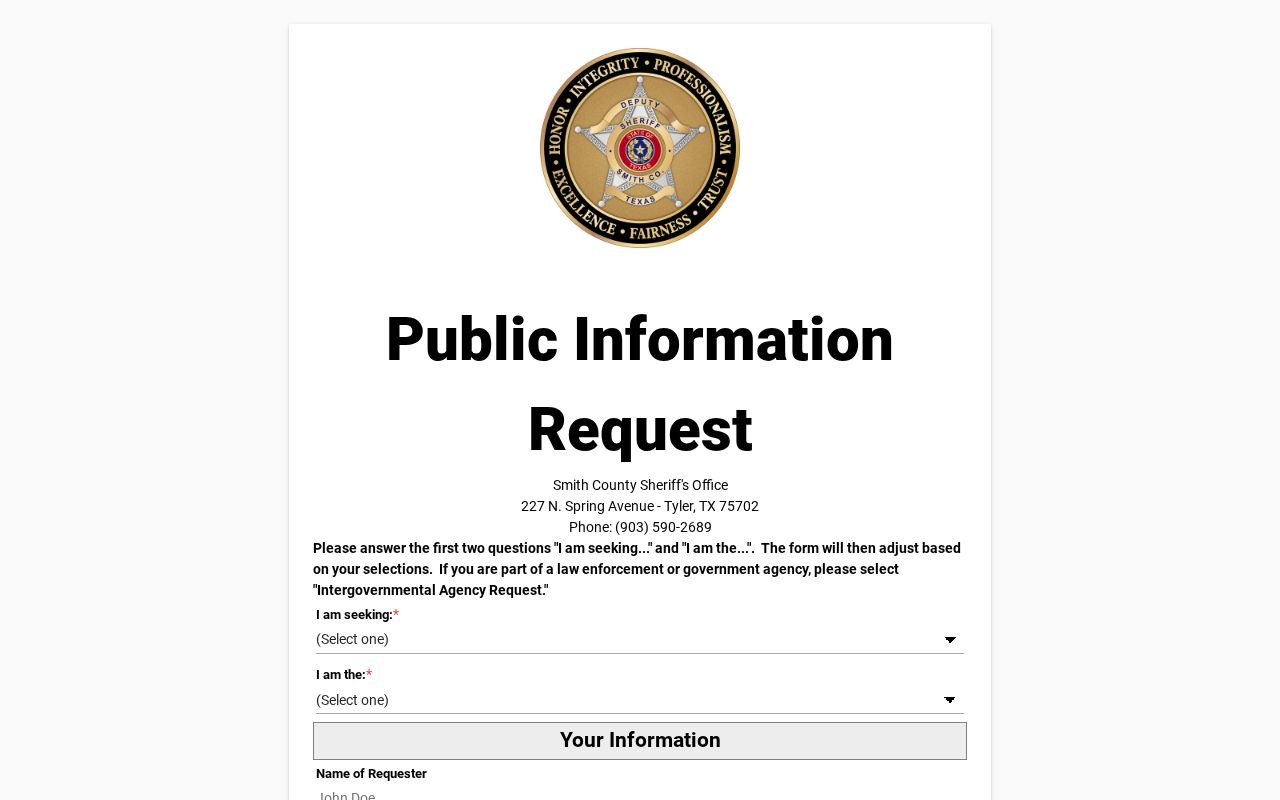
Those fields help tie the requested image to one booking and reduce ambiguity.
Smith County News Photo Checks
An official agency release or a legitimate dated news report may include a booking photo. Read it as evidence of what was published on that date. Then use the court and custody records to learn what happened later. A report about arrest does not establish conviction, release, or present legal status.
Commercial mugshot publishers are not an official source and are not recommended. Their pages may omit disposition, keep stale copies, join an image to the wrong person, or fail to reflect an expunction or nondisclosure order. Do not pay a publisher merely because it claims to control the official record. The government custodian and court clerk are the sound sources for the arrest record and case outcome.
When accuracy is disputed, save the source URL and publication date without republishing the image. Compare the booking identifiers to the Smith County record. Correct the official source first when its own record is wrong, then use Chapter 109 procedures where they apply to a business publisher.
Smith County Mugshot Removal
Expunction and nondisclosure are different forms of court relief. Texas Code of Criminal Procedure Chapter 55A governs expunction. Eligibility depends on the arrest, charge, disposition, timing, and statutory category. A dismissal by itself does not prove that every record was expunged.
A nondisclosure order under Government Code Chapter 411 restricts public dissemination but does not destroy the record. Specified agencies and recipients may retain access. Neither remedy guarantees that every independent copy vanished. Use the signed order and its service record, not an assumption based on a missing portal result.
For an official source, send the signed order to the named custodian and follow its correction process. For a business publisher, consult Chapter 109's current correction, qualifying-relief, and fee rules. Keep the request factual, identify the exact URL and record, and preserve proof of delivery.
Smith County Expunction Photo Routing
Smith County publishes a post-SB 1667 expunction entity list. It names the Sheriff's Office at 227 N. Spring Avenue and Smith County Jail at 206 E. Elm Street among local entities. That list helps identify agencies for a proposed order or later service question.
The list is not a finding that a particular person qualifies. A signed court order and Chapter 55A control. Check the clerk's issuance and service record to see which agencies were covered, then address each remaining source through the applicable process.
For a felony case, the Smith County District Clerk is the court-record custodian. Misdemeanor matters route through the County Clerk. The court order may establish relief, while the Sheriff's response establishes what happened to the booking photograph in its custody. Keep both records.
A precise correction request should state what is wrong. It may identify a mismatched name, an outdated charge label, a missing dismissal, or qualifying court relief. Attach the public order or disposition that supports the correction, but redact sensitive identifiers that are not needed. Ask for a written response and retain it with the original source address.
TDCJ photographs require a separate state route. The no-cost offender-information email service can provide incarceration data but explicitly will not provide photographs. A requester may submit a specific public-information request to TDCJ OGC, yet Section 552.134 and other exceptions may control the answer. Do not promise production merely because a county booking photo might be available under different facts.
If an image is removed from an official portal, an old search-engine preview or news copy can remain for a time. The correct response is to use the host's correction process after the originating record is resolved. Republishing the disputed image while seeking removal spreads the same stale material and weakens the records-focused purpose.