
Understanding Smith County Released Inmates
“Released” describes an exit from a particular custody system, not always a return to the community. The Smith County Sheriff's Office can record a bond release, time served, dismissal-based release, transfer, or another authorized departure from one of its jail components. Central Jail and North Jail are parts of the same county system, so movement between them is not release. A transfer to another Texas county, TDCJ, federal authorities, or ICE also ends one local housing event without making the person free of custody.
The most reliable account joins three kinds of evidence. The jail record supplies physical book-in and book-out facts. The court file supplies the order, bond, dismissal, sentence, or commitment that authorized the change. A receiving agency's record shows what followed a transfer. This distinction matters because a name that vanishes from the live jail search could reflect community release, transfer, a spelling mismatch, restricted data, or a portal delay.
How Smith County Personal-Bond Release Works
Smith County documents a local sequence for a personal bond. The person or helper calls Pre-Trial Release, staff conduct an interview and investigation, and a judge decides whether to approve the bond. After approval, the person signs the required documents and pays the greater of $20 or 3 percent of the bond using an accepted form of payment. Only then does Pre-Trial Release contact the jail to begin release processing.
The sequence matters because judicial approval is not the same timestamp as physical departure. The criminal case is still pending, and the bond is not a dismissal or sentence completion. Keep the signed bond or order with the later jail book-out record.
Smith County Jail Book-Ins and Capacity
The county's FY2025 material reports rated capacities of 660 at Central Jail, 432 at the Low/Medium Risk facility, and 47 at the Courthouse component, for 1,139 total. It also reports 7,381 book-ins in 2022, 7,847 in 2023, and 7,042 in 2024. These figures describe rated space and admissions, not releases and not unique people. One person can account for more than one book-in.
The numbers give operational context but cannot answer whether a named person was released. A person-specific booking, court, or custody record is still required.
Which Smith County Clerk Holds the Release Order?
Felony matters belong with the Smith County District Clerk, while misdemeanor criminal matters belong with the County Clerk. Records Services reports online criminal indexing from 1995 forward. A docket can preserve the bond, dismissal, judgment, sentence, commitment, probation, revocation, or discharge entry after a name leaves the live jail view.
The District Clerk's official page explains the felony search and copy route. The screenshot below shows where that route begins.
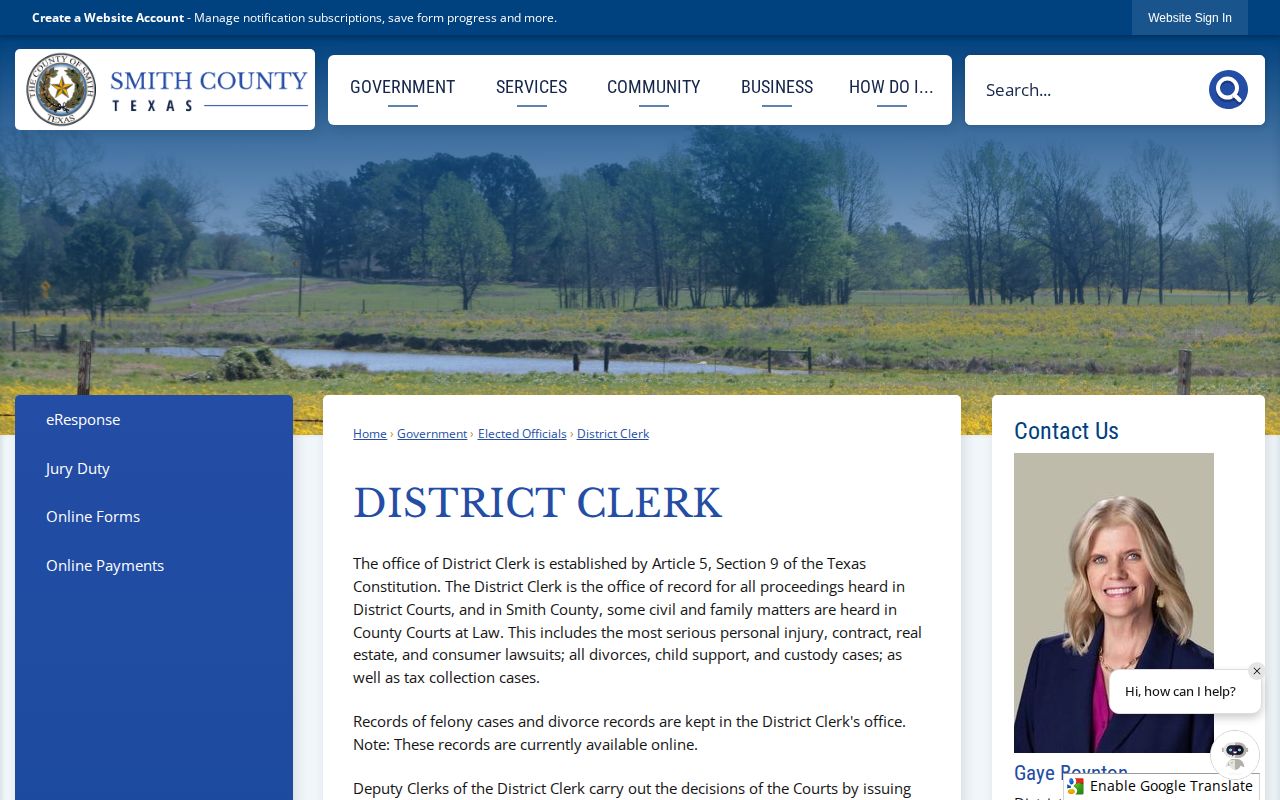
A filed order explains legal authority. For exact physical departure, pair it with the Sheriff's book-out time.
Smith County Expunction Agency Routing
Smith County publishes an entity list created after SB 1667 that identifies the Sheriff's Office and Jail among local custodians used in expunction work. That list helps identify agencies, but it does not decide eligibility or replace a signed order under Chapter 55A. The arrest, charge, result, timing, and statutory category control.
After an order is signed, review which agencies it covers and whether the clerk issued or served it. Nondisclosure under Chapter 411 is different because it limits public dissemination without necessarily destroying the record. Neither remedy supports a promise that every copy held outside government disappears.
Smith County Jail Release Paths
The exit reason determines which office can verify the next step. A signed order may explain legal authority, but the Sheriff's book-out timestamp is better evidence of physical departure. The receiving agency must confirm a transfer.
| Release path | Meaning | Best next record |
|---|---|---|
| Bond or personal bond | The case continues outside the jail under stated conditions. | Bond order, court docket, and Sheriff book-out record |
| Time served or sentence complete | The county confinement ordered in that matter has ended. | Judgment, sentence credit, and book-out disposition |
| Dismissal or other court authority | One charge may end, though other holds can remain. | Filed order plus a check of every booking charge and hold |
| TDCJ commitment | The person leaves county custody for the state prison system. | TDCJ search for a current sentence and later written history |
| Other custody transfer | Another county, federal agency, or ICE may receive the person. | Smith County transfer destination and receiving-agency confirmation |
A transfer should be reported as a transfer, not as a community release. That narrow wording prevents a local roster change from being mistaken for the end of all custody.
Fields in a Smith County Release Record
No single public screen is guaranteed to show every useful field. A focused Public Information Act request can identify the existing booking, custody, hold, and exit records tied to one person and date range.
| Field | What it establishes |
|---|---|
| Name, aliases, DOB, booking or case number | Connects the response to the intended person and booking. |
| Book-in and book-out timestamps | Marks entry and physical departure recorded by the jail. |
| Facility and custody-location history | Separates a Central-to-North move from departure from Smith County custody. |
| Release disposition or type | Identifies bond, time served, transfer, or another recorded outcome. |
| Authorizing order or agency | Points to the legal or administrative basis for the exit. |
| Hold clearance and transfer destination | Shows whether another authority delayed or received custody. |
| Booking photograph | Links an image to the specified booking when lawfully releasable. |
A court judgment can prove disposition, sentence, or a release-related order, but it does not necessarily give the moment jail processing ended. Conversely, a book-out time does not explain every continuing court or supervision obligation. Use both records when the distinction matters.
Request Smith County Book-Out Records
Use the county's direct JustFOIA request form when the public portal does not display the needed exit facts. Ask for existing records rather than asking staff to research whether someone is released.
- Identify the full name, aliases, DOB if known, booking or case number, and a narrow arrest date range.
- Request the booking sheet, book-in and book-out time, release disposition, authorizing record, hold clearances, custody history, and receiving agency.
- List the booking photograph separately if it is needed, and request electronic copies where available.
- Ask for releasable portions and the legal basis for anything withheld. Set a cost-notice ceiling appropriate to the request.
- For a felony or misdemeanor order, contact the correct clerk instead of routing judicial records through the Sheriff's request.
The Texas Public Information Act requires prompt handling, but ten business days is not a universal production deadline. That period often concerns an agency request for an Attorney General ruling. If estimated charges exceed $40, Government Code Section 552.2615 supplies an estimate and response process. Active-case exceptions, confidential identifiers, victim data, juvenile records, and sealed or expunged material may lead to withholding or redaction.
The captured form shows the practical fields a requester encounters:
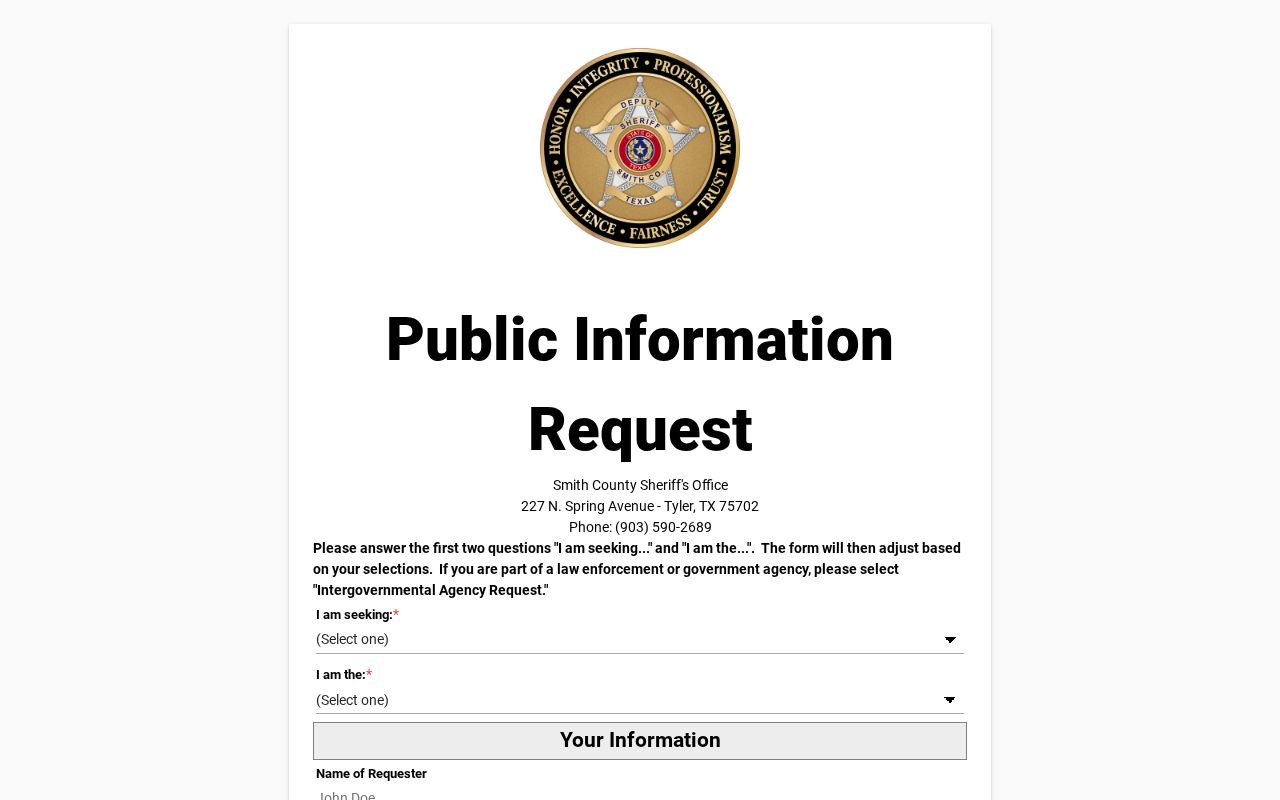
The form is the start of a documented request, not an instant release-status lookup.
Texas Rules for Smith County Release Records
Texas Government Code Chapter 552 provides access to government information subject to record-specific exceptions. Section 552.221 addresses prompt production, while cost, estimate, and deposit rules appear in Sections 552.261 through 552.275. Court files follow the clerk's process and applicable judicial-record rules rather than the ordinary executive-agency route.
Texas Code of Criminal Procedure Chapter 55A governs expunction. Government Code Chapter 411 governs nondisclosure, which restricts public dissemination but is not the same as destruction. A dismissal alone does not prove that every record was expunged. Always examine the signed order, covered agencies, and clerk service record.
Find a Released Smith County Inmate
Begin with identity and jurisdiction, then follow the custody chain. Do not treat two blank searches as proof of release.
- Search the Smith County public portal and Odyssey using the full name, known aliases, booking number, or case number available to you.
- Open the related felony or misdemeanor court case. Read the actual order or judgment when a docket label is unclear.
- If a felony commitment appears, search TDCJ by name, seven-digit TDCJ number, or SID. A county roster disappearance may be a state transfer.
- If the record names another county, BOP, USMS, or ICE, use that receiving system and match identifiers and dates.
- When online fields do not settle the result, request the Smith County book-out disposition, hold clearances, custody history, and receiving agency through JustFOIA.
The county publishes no separately labeled same-day feed. The Released Last 24 Hours guide therefore leads with the portal, court, phone, and written-request fallback rather than presenting a nonexistent list.
TDCJ Search After a Smith County Transfer
The Texas Department of Criminal Justice search covers current TDCJ sentences. It is not a complete historical archive of every discharged former prisoner, and it does not replace Smith County jail records. Use it when the county case shows a state commitment or other evidence points to TDCJ.
| Search input or result | How to use it |
|---|---|
| Last and first name | Start broad, then match identity and Smith County conviction details. |
| TDCJ number or SID | Prefer a known identifier to reduce same-name mistakes. |
| Location and current offense | Confirm present state custody and the sentence being displayed. |
| Projected Release Date | Treat as planning information that may change, not proof of departure. |
| Parole Review Information | Read review and vote details separately from release dates. |
The official search screen illustrates the available identity fields:
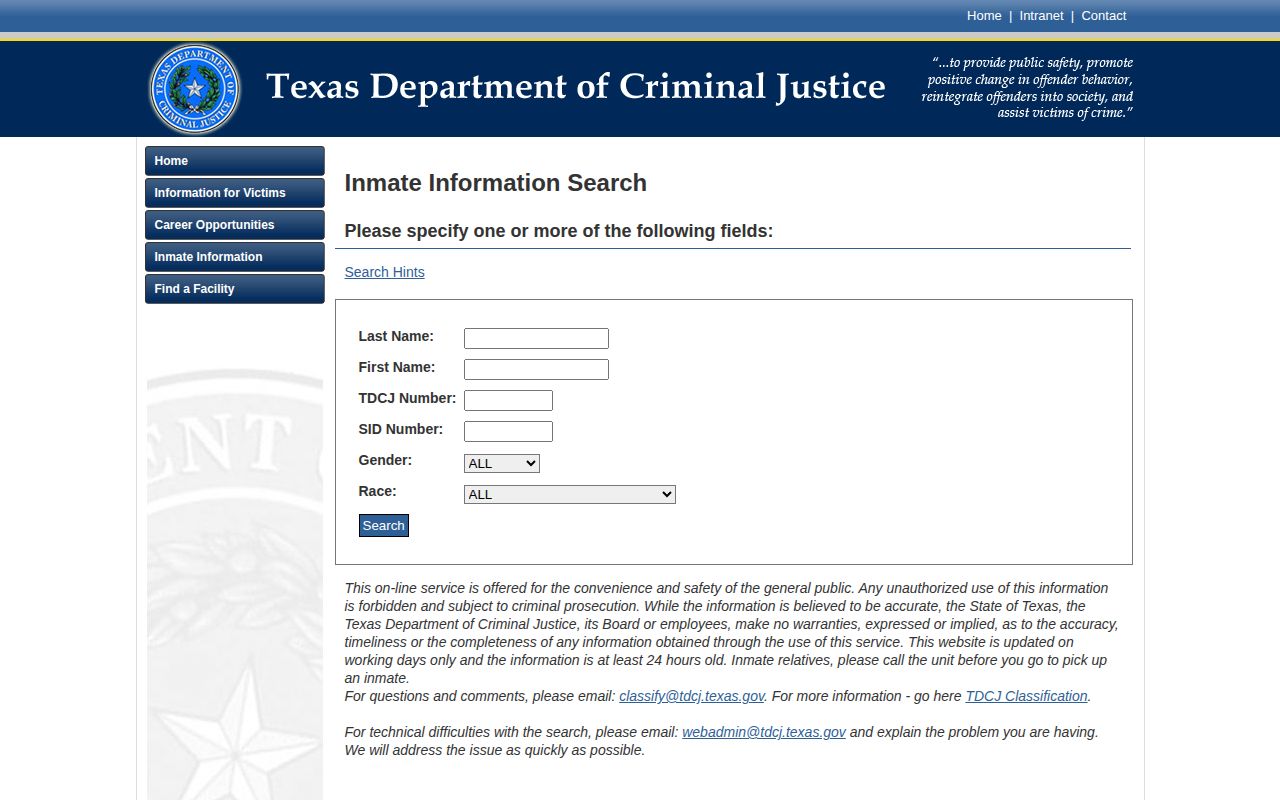
If a fully discharged person is absent, use TDCJ's no-cost inmate-information email for basic incarceration history or its OGC public-information process for a release or discharge record. The email service expressly excludes photographs.
Smith County Recent Release Search Limits
Smith County provides a combined jail and court portal, but the research found no official page labeled as a 24-hour or 72-hour release feed, no promised update cadence, and no stated public retention window for released entries. The portal can help locate a booking or case link. It cannot turn a missing result into proof.
The official Smith County landing page shows the available jail and court routes:
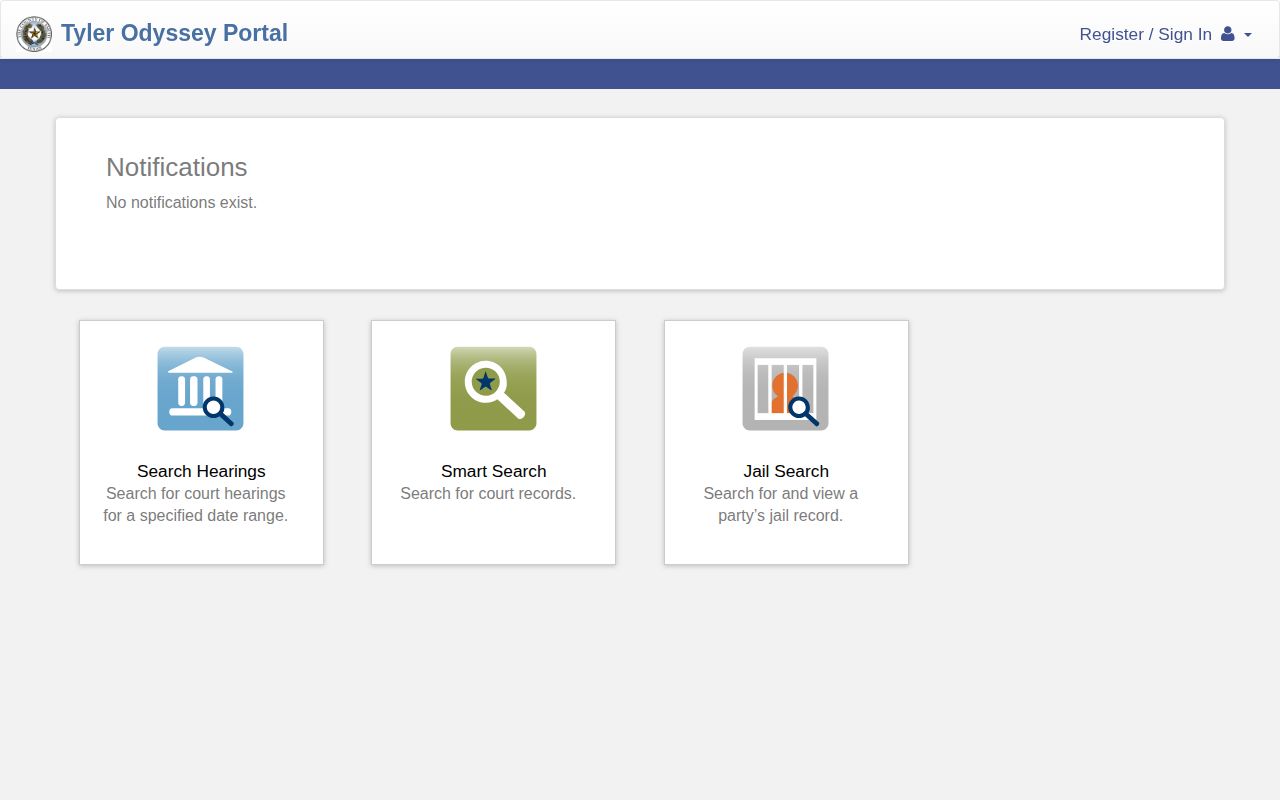
For a durable same-day answer, record what the portal showed, call the jail information line at 903-590-2800, check the court case, and request the book-out entry if needed. Ask whether departure was community release or transfer.
Smith County Post-Release Supervision Checks
Texas parole and Smith County probation are separate. TDCJ Parole Division supervises parole and mandatory supervision from state prison. The Smith County Community Supervision and Corrections Department handles court-ordered probation. Pre-Trial Release monitors some people before their criminal cases are resolved.
Smith County maps to the Tyler District Parole Office. For probation, Case Connect is participant access rather than a public name search, so a public status check begins with the court case. Early discharge from probation requires a court order and cannot be calculated simply from the original sentence. The Parole / Probation page explains the distinct verification routes.
Smith County Notifications and Outside Custody
Texas replaced the legacy county VINE framework with Texas IVSS-Counties effective September 1, 2025. Existing registrations migrated, but users should update passwords and preferences and confirm whether Smith County and the needed event are supported. TDCJ runs a separate IVSS system for prison, parole, and mandatory-supervision events. A notice is useful and person-specific, but it is not a certified historical record.
Federal custody requires a different search. The BOP locator covers federal inmates from 1982 forward and may show a past Release Date with “Released” or “Not in BOP Custody.” That confirms departure from BOP, not freedom from all authorities. ICE ODLS uses an A-number and country of birth, or exact name, DOB, and country of birth, and includes some releases from the prior 60 days subject to exclusions and lag.
The BOP locator displays the name and number routes shown here:
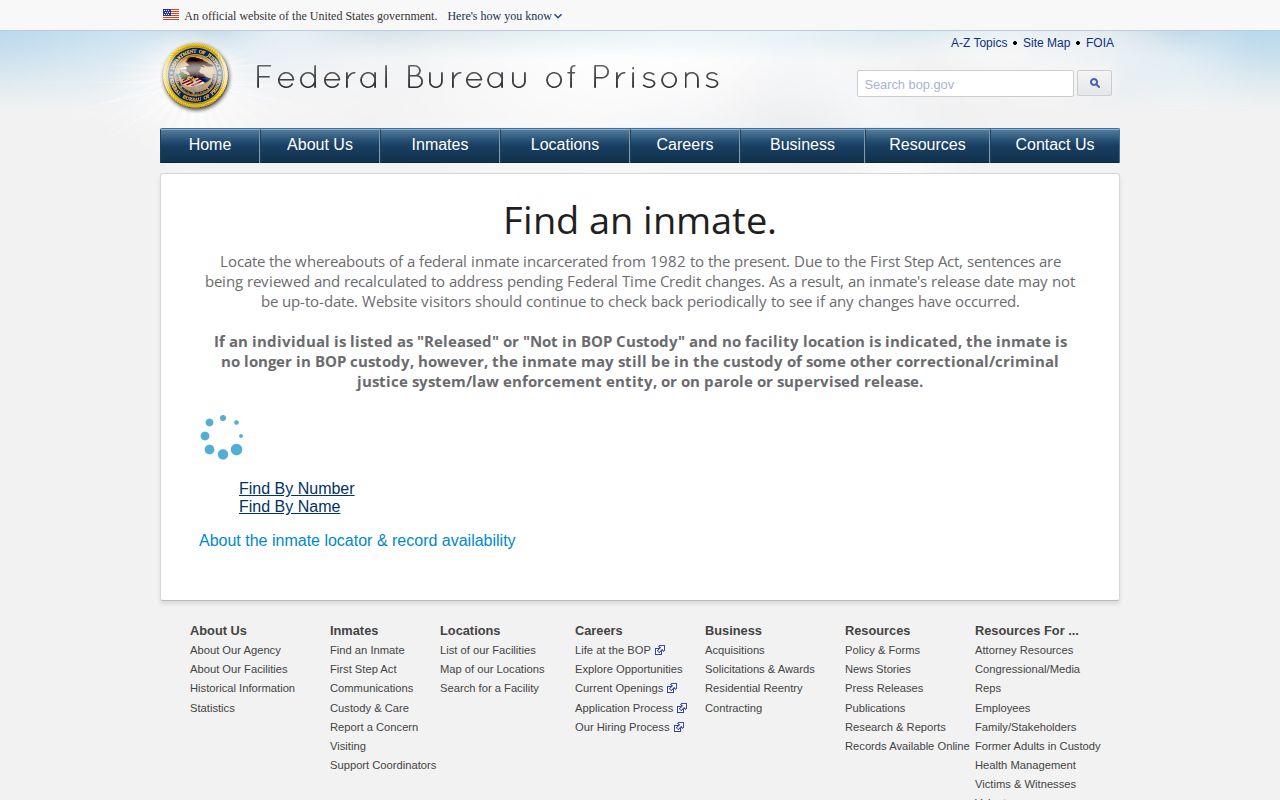
Match the federal result to the Smith County case before joining records for people with similar names.
Where Smith County Release Status Appears
Choose the system that held the person. Each source answers only within its own jurisdiction.
| Source | Best use | Important limit |
|---|---|---|
| Smith County live jail search | Present local custody and booking/case starting points | A released person may disappear; no-hit is inconclusive |
| Sheriff book-out record | Physical exit time, disposition, and transfer destination | May require a written request and redactions can apply |
| District or County Clerk | Bond, dismissal, judgment, sentence, and discharge orders | Judicial action is not necessarily the door-exit time |
| TDCJ search and records | Current state sentence, projected date, and historical fallback | Online coverage is limited to current sentences |
| BOP or ICE locator | Federal or covered immigration custody and departure | Release from one authority may lead to another |
Smith County Jail Components and Releases
The Sheriff's custody record should identify the component history. Always separate movement inside the system from departure from the system.
- Smith County Central Jail is the primary county custody point at 206 E. Elm Street. Departures may be community releases or transfers.
- Smith County Low/Medium Risk Jail (North Jail) is another campus in the same Sheriff-operated system. A move there from Central is not release.
- Smith County Courthouse Jail appears in historical and budget sources as a fifth-floor trustee component. Confirm its current role before describing any departure from it.
No TDCJ prison, BOP institution, or ICE detention center was verified inside Smith County. Those systems still matter when another authority receives custody.
When Smith County Sends Custody Elsewhere
Smith County's budget material says overflow prisoners may be contracted to other Texas counties. A name can therefore leave the local housing view while the person remains jailed elsewhere. Ask the Sheriff for the destination and receiving agency instead of searching every nearby county by guesswork.
The same care applies to a TDCJ commitment, federal writ, or immigration detainer. Use the exact transfer time and agency, then confirm the receiving record. A writ return or a move between Central and North Jail is not a community release.
Which Smith County Release Fees Are Real?
The local personal-bond process calls for the greater of $20 or 3 percent of the bond after approval. That is a specific pretrial payment, not a universal jail “release fee.” Probation fees and other court obligations may remain, but they belong in the participant or court channels and should not be confused with payment demanded to make a jail release happen.
Smith County has warned about callers impersonating Pretrial Services, the Jail, or Sheriff's personnel and demanding Bitcoin, Cash App, or Venmo for bonds or ankle monitors. The county states that law enforcement does not call asking for payment. Verify any claimed obligation through the official county page or office number.