
Smith County Parole Versus Probation
Parole and probation both permit a person to live in the community under rules, but they begin in different ways. Parole follows release from a TDCJ prison sentence. Mandatory supervision is another form of state-supervised release when the governing statutes and Board decision permit it. Probation, called community supervision in Texas law, comes from a court order and is managed locally by the Smith County Community Supervision and Corrections Department. Pretrial release is separate because the criminal case has not reached a final judgment.
| Status | Who orders it | Smith County contact | Best proof |
|---|---|---|---|
| Parole | Texas Board of Pardons and Paroles | TDCJ Tyler District Parole Office | TDCJ record and release certificate |
| Mandatory supervision | Statutory process and Board review | TDCJ Parole Division | TDCJ release and supervision record |
| Probation | Sentencing court | Smith County Adult Probation | Signed court order and CSCD record |
| Pretrial monitoring | Court before disposition | Smith County Pre-Trial Release | Bond order and current case docket |
The distinction matters. Leaving Smith County Central Jail does not prove that parole or probation began. The court judgment or TDCJ release record identifies the legal status. Movement to North Jail, another county, TDCJ, federal custody, or immigration custody is a transfer, not community supervision.
- Parole
- Conditional release from a TDCJ prison sentence before the sentence fully expires.
- Probation
- Court-ordered community supervision, often imposed instead of or after some jail time.
- Discharge
- The formal end of a sentence or supervision term.
- Absconder
- A person alleged to have stopped reporting or whose location is unknown to the supervising authority.
Verify Smith County Post-Release Supervision
Start with the sentence, not a guess based on where the arrest occurred. Smith County may be the county of conviction even when the person served a state sentence elsewhere. A county probation case, by contrast, may never create a TDCJ prison record. Use exact identifiers whenever possible because similar names can lead to the wrong case.
- Search the Smith County public portal for the criminal case. Confirm the court, case number, judgment, and any probation or revocation order.
- For a state sentence, use the TDCJ Online Inmate Search. Read the current location, projected date, and Parole Review Information link when present.
- If the person is on parole or mandatory supervision, confirm the office through the TDCJ county office index. Smith County maps to the Tyler office.
- For probation, use the court order as the public record. Case Connect is restricted to participants and is not a public name search.
- When a durable record is needed, request the applicable discharge, release, or court document from its custodian.
The Smith County released-inmate search paths can help distinguish a true community release from a transfer. The jail book-out record proves departure from county custody. It does not, by itself, identify every later duty.
Smith County Supervision Offices
State parole and local probation have separate doors, files, and staff. The TDCJ Region I directory lists the Tyler District Parole Office for Smith County. The Smith County Adult Probation page routes people with community-supervision matters. Neither office should be asked to interpret the other agency's order.
3915 Market Drive
Tyler, TX 75701
Phone: 903-581-8311
Fax: 903-581-8016
217 E. Line Street
Tyler, TX
Phone: 903-590-2700
Fax: 903-590-2726
A participant may use Case Connect to view reporting information, fee balances, the next appointment, and officer information. Setup may require a Web Report ID, and local instructions mention identification for kiosk use. Those details are private participant services. For a public probation status, return to the signed judgment, supervision order, modification, revocation, or discharge order in the court file.
The official Adult Probation view is shown on the Smith County agency page.
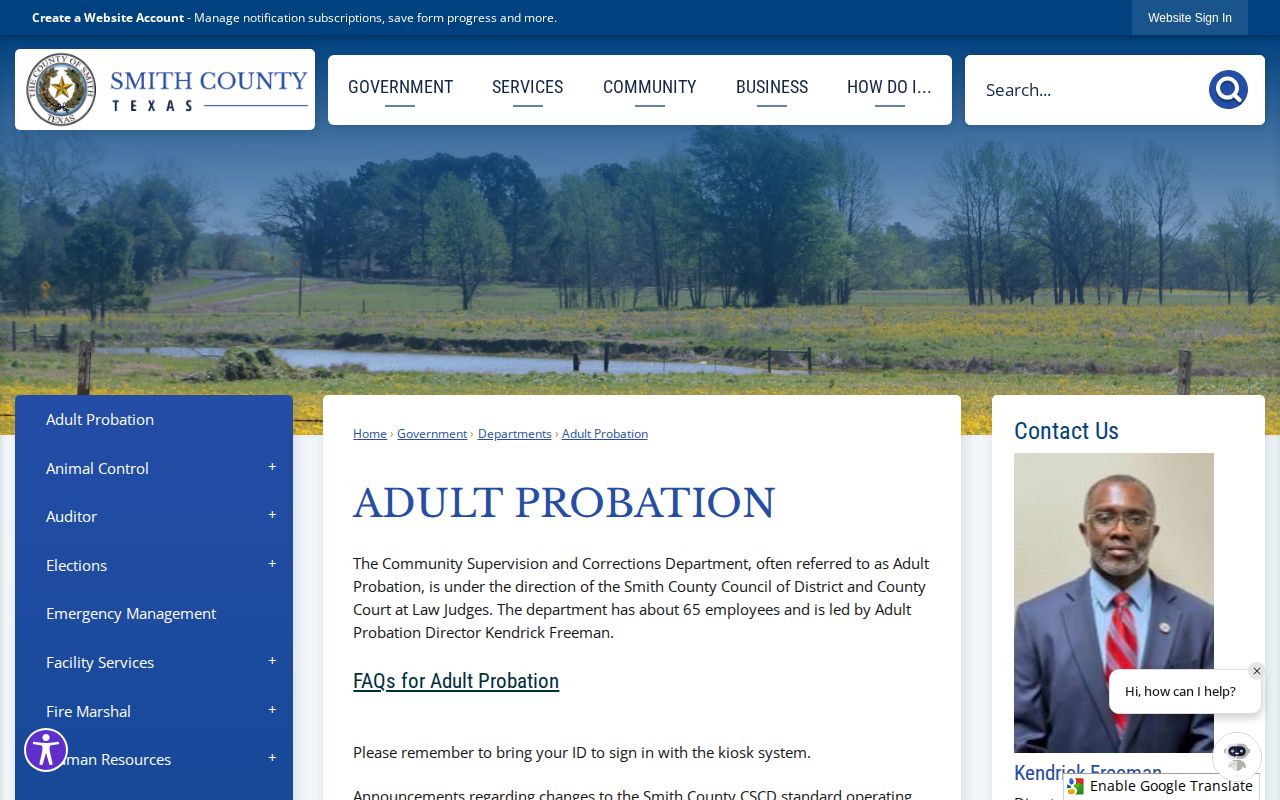
This agency page confirms the local route for probation, while TDCJ remains the correct route for parole.
Smith County Supervision Violations
Conditions vary by the signed order or parole certificate. They may include reporting, approved travel, treatment, program participation, payment duties, or other person-specific terms. A violation allegation does not explain itself. The supervising agency may respond with instructions, a warrant, a modification, or a revocation process. Revocation means a court or parole authority considers whether supervision should be withdrawn because of an alleged breach.
An absconder listing is narrower than a general supervision search. TDCJ maintains a specialized Sex Offender Absconder Information Search, but it is not a list of every parole warrant or every person who missed a probation report. No hit does not prove compliance. General warrant questions belong with the issuing court or responsible law-enforcement agency, and active participant questions belong with the assigned officer.
Texas notification systems may report certain custody or supervision changes. TDCJ IVSS covers state prison, parole, and mandatory-supervision events. Texas IVSS-Counties replaced the old statewide county VINE framework in 2025, subject to county participation and supported events. Alerts are useful, but they are not certified records and may lag the source agency.
Smith County Supervision Discharge
Supervision ends through a formal act, not merely because the original date seems to have passed. For parole or mandatory supervision, request or retain the TDCJ record that states discharge status and date. For Smith County probation, obtain the signed discharge or termination order from the court, or confirm the participant record with CSCD. A release from jail and a discharge from supervision are distinct events.
Early discharge from probation is not automatic. The Smith County Adult Probation FAQ says only the court can order it after considering time served, completed conditions, payments, compliance, and applicable eligibility limits. Do not subtract calendar time from the original term and present the result as fact.
Texas Government Code Chapter 508 governs major parole and mandatory-supervision rules. Court-ordered community supervision is addressed in Code of Criminal Procedure Chapter 42A. The controlling judgment, offense date, and later orders still determine the individual result.
Two Smith County Supervision Routes
Smith County's local setup makes the agency divide especially clear. State parole maps to the Tyler DPO on Market Drive. County probation operates from East Line Street and provides participant-only Case Connect. There is no single public probation lookup that can be searched like the TDCJ inmate tool.
That means a careful verification uses two records when needed. The public court file shows whether probation was ordered, modified, revoked, or discharged. The participant or agency channel handles current reporting details. For parole, the TDCJ person record and Parole Review Information provide the public starting point, while the Tyler DPO handles appropriate office routing. Prerelease residential plans are confidential and should not be inferred from an office address.
Keep the conclusion narrow. “The judgment placed the person on probation” is supported by the order. “The person completed probation” requires a discharge record. Likewise, a parole approval vote is not proof of physical release; release processing and any holds must also clear.
Written records are useful when a phone answer cannot be preserved. For a parole history, identify the full name, TDCJ number when known, county of conviction, and the specific release or discharge record sought. For probation, identify the Smith County case number and request the judgment, conditions, later modifications, revocation filings, and discharge order as applicable. A clerk can provide filed court records, while supervision staff control participant records.
Privacy limits still apply. TDCJ states that prerelease residential plans are confidential, and a district office address is not the person's home address. Case Connect also exists for the participant, not the public. Verification should establish the legal status and responsible office without seeking private reporting details or drawing conclusions beyond the record.
When a person is arrested again during supervision, the new Smith County booking and the older supervision case remain separate records. A parole warrant may place the person in county custody pending state action. A probation revocation filing may lead to a hearing in the sentencing court. Neither event should be described as a new conviction unless the court record supports that result.