
Smith County Projected Versus Actual
TDCJ defines Projected Release Date as an administrative calculation based on the offense title and date, sentence data, credits, and the release rules that apply. It reflects a possible future exit if an earlier parole release does not occur. A Scheduled Release date appears later, after processing has advanced. Even that date may change, including on the scheduled day.
Actual release is a past event shown by a book-out time, release certificate, discharge record, or custody history. These records answer a different question. A future date cannot prove that a person left custody. Likewise, a parole approval vote does not show that release-plan checks, holds, and final processing have finished.
A Smith County pretrial detainee usually has no sentence-based release date. Bond approval, dismissal, a court order, or transfer may change custody, while another hold may prevent community release. The local court record explains legal authority. The Sheriff's book-out record establishes the actual exit from Smith County custody.
Find Smith County Projected Dates
The place to search depends on who holds the sentence. No TDCJ prison sits in Smith County, but a conviction from Smith County can still lead to TDCJ custody elsewhere. A county-jail sentence does not become a TDCJ sentence merely because it was imposed in Texas.
- Read the judgment or commitment in the Smith County portal. Identify a county sentence, a TDCJ commitment, or pretrial status.
- For a state sentence, search the TDCJ Online Inmate Search by TDCJ or SID number when known. Otherwise use the exact name and available refiners.
- Open Offender Information Details. Read location, current offense, Projected Release Date, and Parole Review Information when shown.
- For a county sentence, call the Smith County jail at 903-590-2800 and request the jail's time-computation record if needed. Do not apply a prison formula.
- For historical proof or a missing TDCJ result, use TDCJ's no-cost information email route or request the specified release certificate through TDCJ OGC.
The Smith County release-record search helps when a person has vanished from a live roster. A no-hit can mean transfer, full discharge, a data mismatch, county-only custody, or another jurisdiction. It is not release proof.
The official TDCJ search fields are visible at the state offender search.
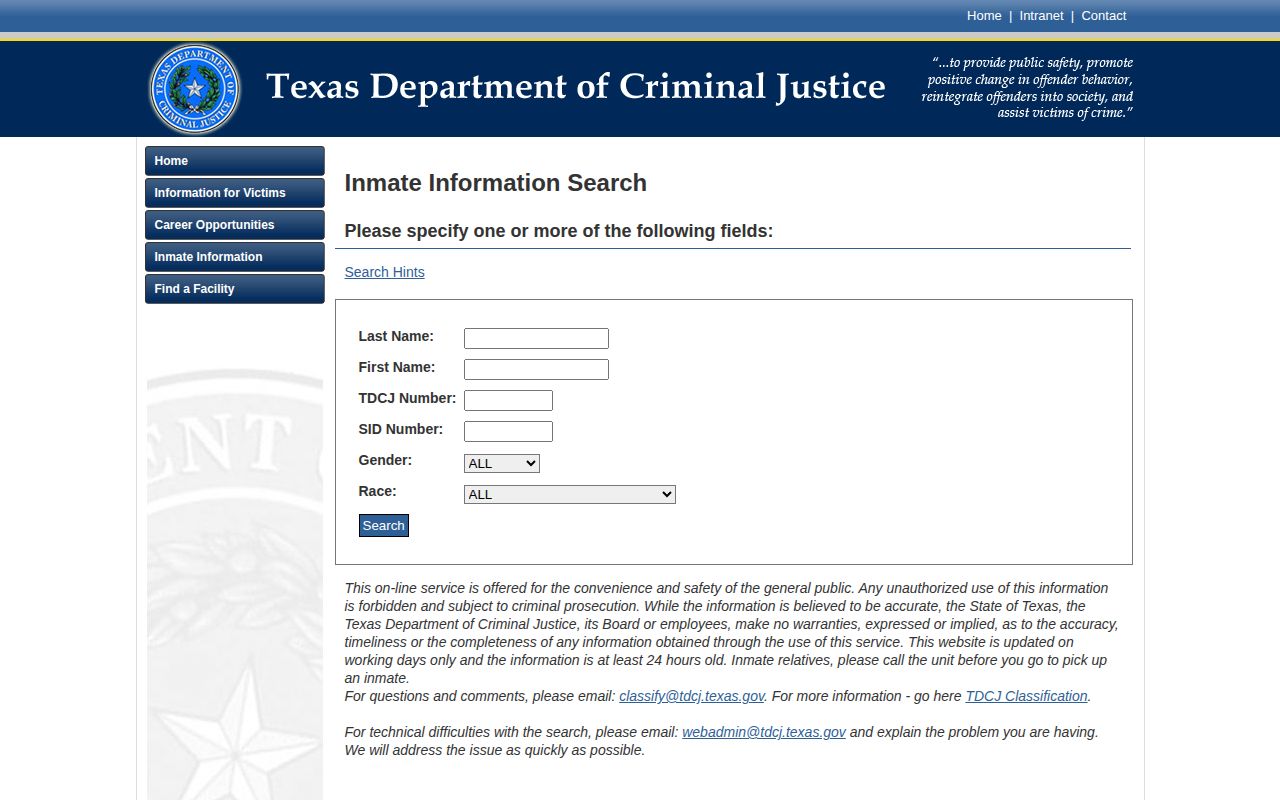
The identifier fields reduce name collisions before the projected date is read.
Texas Good Time Calculations
Texas Government Code Sections 498.002 through 498.004 govern good-conduct time. Classification and eligible activity can add credit. Section 498.003 includes up to 15 extra days for each 30 days actually served for diligent participation in specified programs. Section 498.004 governs forfeiture and restoration. Credit can affect a statutory calculation, but it does not promise parole.
Mandatory supervision rules depend heavily on the offense date and eligibility. For certain eligible offenses before September 1, 1996, flat time plus good time reaching the sentence may set the projection. For later eligible offenses, discretionary mandatory supervision also requires Board approval. A denial can move the projected date to maximum expiration. A later approval may move it earlier.
Texas has no general rule requiring every prisoner to serve 85 percent. For offenses identified through Article 42A.054, Government Code Section 508.145(d) commonly sets first parole eligibility when actual calendar time equals one-half of the sentence or 30 years, whichever is less, subject to minimums and special rules. Section 508.149 lists mandatory-supervision exclusions. The judgment, offense date, and statute control.
County jail credit is separate. Code of Criminal Procedure Article 42.032 permits a sheriff to grant qualifying commutation, generally up to one day for each day actually served for good conduct, within statutory and local limits. No public Smith County policy was found that supports calculating a specific person's date from the outside. Ask for the actual computation.
Why Smith County Dates Change
Sentence calculations depend on live records. A later audit can correct credit, offense data, consecutive sentences, or eligibility. Release planning also tests whether another authority has a hold. A detainer is a request or notice from another agency that may cause transfer rather than community release.
| Factor | Possible effect | Record to verify |
|---|---|---|
| Good-time loss or restoration | Moves an eligible calculation later or earlier | TDCJ time sheet or classification record |
| Board decision | Approval, denial, or setoff changes the path | Parole Review Information and vote record |
| Detainer or hold | May delay exit or cause transfer | Hold log and receiving-agency record |
| Court correction or new sentence | Changes time and sequence | Signed judgment or amended order |
| Required program or release plan | May delay practical scheduling | TDCJ processing record |
TDCJ says Classification and Records generally completes an audit and calculation after a release certificate, often in a 14 to 21 business-day stage. The overall certificate process may take roughly four to six weeks, depending on the case. These are processing descriptions, not guaranteed release windows.
Confirm Smith County Actual Release
For county custody, request the book-out date and time, release disposition, cleared holds, and any receiving agency through Smith County JustFOIA. For state custody, request incarceration history and the release or discharge certificate from TDCJ. State parole, mandatory supervision, full discharge, and transfer are not interchangeable outcomes.
The VINELink Release Check explains the current Texas IVSS channels and legacy VINE context. TDCJ IVSS covers state prison and parole events. Texas IVSS-Counties is the current county notification framework, subject to participation. An alert can help mark a change, but it is not a certified custody record.
The TDCJ Ombudsman explains the difference between projected and scheduled processing on its parole FAQ.
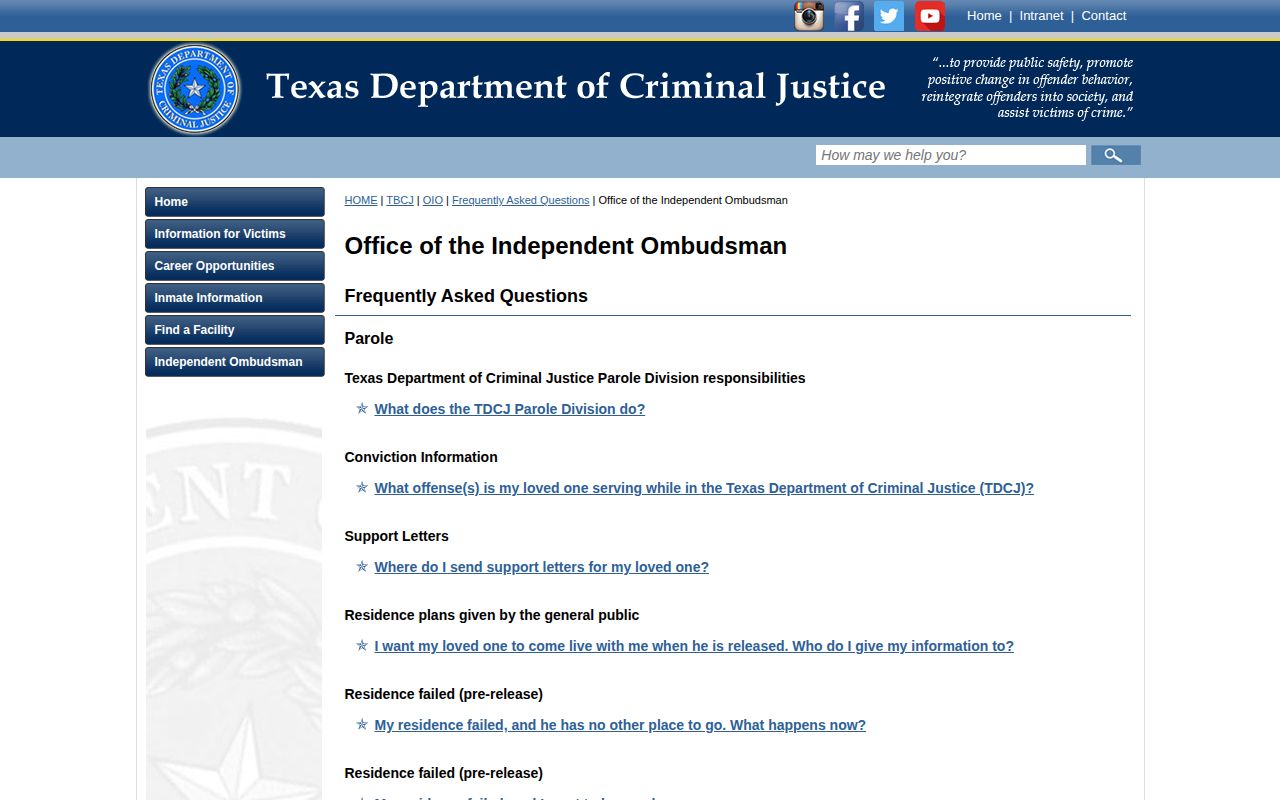
The official warning supports a final check even when the scheduled date has arrived.
Texas Mandatory Supervision Changes
Discretionary mandatory supervision can cause a sharp change in a Smith County state prison projection. A Board denial may recalculate the date to maximum expiration or full discharge. A later approval can bring the expected date forward. That movement is lawful processing, not necessarily a data error.
Scheduled dates can also change on the named day. Holds, record audits, required programs, and release-location work may still matter. Read eligibility, Board action, scheduling, and actual release as four separate milestones. Each needs its own source.
For an aggravated offense, reject the common 85-percent shortcut. Section 508.145(d)'s one-half actual-calendar-time or 30-year cap framework may apply, along with offense-specific minimums. Legal advice on a particular judgment belongs with a qualified attorney; the public records can establish what TDCJ calculated and why it later changed.
Parole eligibility is only the first date on which the Board may consider release. It is not a command to release the person. A Board panel can approve, deny, or set the matter for later review under the available vote options. The person-specific Parole Review Information record should be read beside the projected date rather than collapsed into it.
Maximum expiration is also distinct from the date someone enters the community. A person can leave one facility by transfer, remain held on another case, or enter supervision before the sentence's final discharge. Request records that name the release type and receiving authority. A bare date without a disposition can misstate what occurred.
County calculations deserve the same care. Smith County records may include jail credit ordered by the court and locally administered commutation. Only the custodian's time sheet can show what was applied. Weekend timing, property return, exit location, and transport arrangements were not published in the research and should be confirmed directly before anyone travels.
Smith County Sentence Records Behind the Date
A county court record can explain why a date exists even when it cannot predict the exact moment a jail door will open. For a felony, obtain the judgment and sentence from the Smith County District Clerk. For a misdemeanor, use the County Clerk. Review jail-time credit, the offense of conviction, sentence length, concurrent or consecutive terms, commitment language, probation orders, revocations, and any later modification. A docket label is a useful index, but the filed order is stronger evidence.
For a county-jail sentence, ask the Sheriff for the existing custody calculation or book-out record and compare it with the judgment. Texas Code of Criminal Procedure Article 42.032 addresses county-jail commutation, but the public should not calculate an individual date from the statute alone. Credits, holds, other cases, and the jail's actual records can change the result.
For a state sentence arising in Smith County, use the judgment to check the TDCJ result and identifier. If the online page is blank because the sentence is no longer current, request incarceration history through TDCJ's no-cost information email or ask OGC for the release or discharge record. This chain preserves the difference between a court-imposed term, a projected date, a scheduled location and date, and the actual recorded departure.